The Words You Use Are Not Neutral
Most people think behaviour changes first. They believe if they try harder, get motivated, or set better goals, things will improve. But behaviour rarely leads the way. Your words do.
The language you use, especially the language you use with yourself, reflects how you see yourself, what you believe is possible, and the purpose you are acting toward. Your words are a clear expression of your identity, beliefs, and attitudes. That’s why changing your language is often the first step to changing your behaviour.
If you want to understand why you do what you do, start by listening to what you say.
Your Words Shape Your Identity (And Identity Drives Behaviour)
Every sentence you speak carries an implicit statement about who you believe you are.
“I’m terrible with money.”
“I’m just not a confident person.”
“I’m not good at difficult conversations.”
These aren’t harmless observations. They are identity statements. And identity is powerful. Once you unconsciously decide who you are, your behaviour will work hard to stay consistent with that story. This is why motivation often fails, it’s trying to push behaviour in a direction your identity doesn’t support.
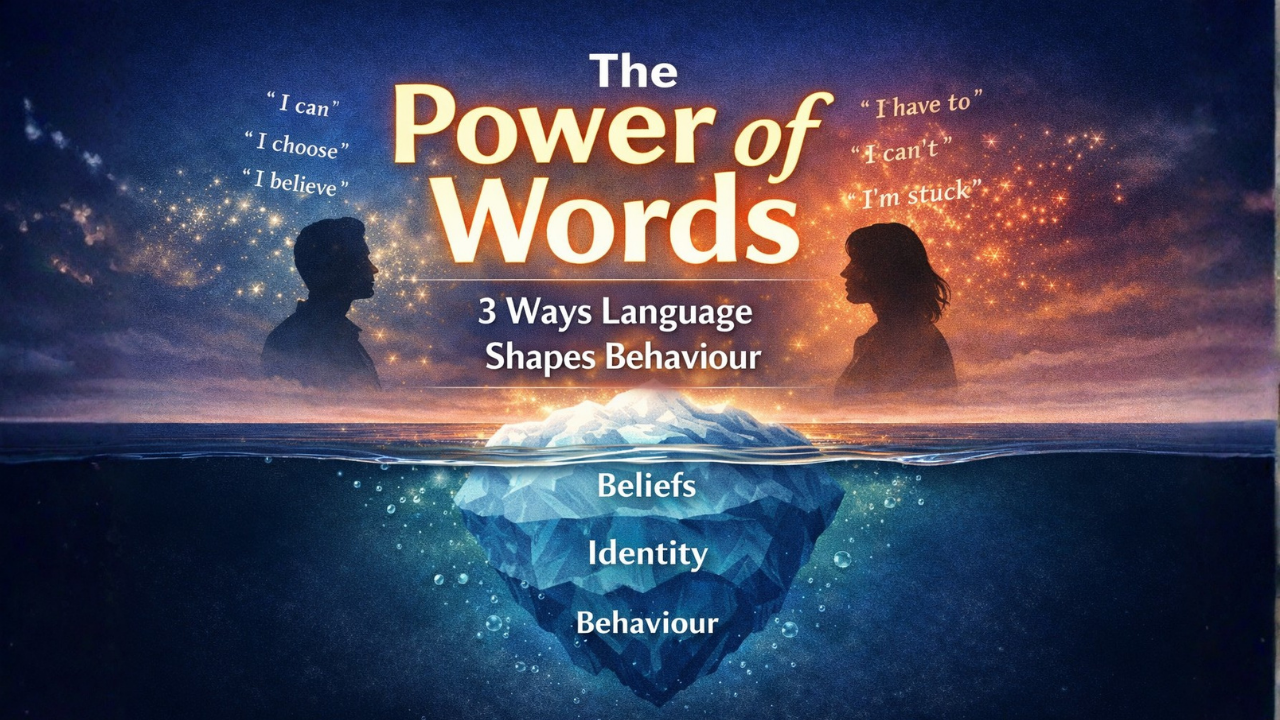
Think of identity as living below the surface of the Integrated Values Iceberg. Above the waterline, we see outcomes and behaviours. Below the surface live beliefs, identity and purpose. Language operates at this deeper level.
When you change your language from “I can’t” to “I’m learning how to”, you’re not just being positive. You’re giving your unconscious permission to act differently. You’re reshaping the identity that drives your behaviour. Think about it this way … you don’t behave your way into a new identity … you speak your way into it.
Language Determines Whether You Take Responsibility or Give It Away
One of the clearest ways language shapes behaviour is through responsibility. Listen closely to phrases like:
- “It made me angry.”
- “I had no choice.”
- “I have to do this.”
- “They forced my hand.”
This language places control outside the self. When you speak this way, you subtly reinforce the belief that you are a passenger in your own life. And when responsibility disappears, so does personal power.
Now compare that with:
- “I chose to respond that way.”
- “I decided this mattered.”
- “I noticed I was avoiding it.”
These phrases do something important—they return ownership to you. This isn’t about blame. It’s about power.
When you own your choices through language, your behaviour shifts naturally. You start looking for options instead of excuses. You move from reaction to intention. Responsibility becomes something you take, not something that is imposed.
Be careful what you wish for … if your words remove choice, they also remove influence.
Your Unfiltered Words Reveal What You Really Believe
The most honest language you use is often the language you don’t plan. What slips out when you’re tired. What you mutter under your breath. What you say when you’re frustrated, defensive, or emotional.
This language can provide a wonderful insight into what you are thinking.
It reveals unconscious beliefs you may not realise exist. That’s why ignoring your own words is a missed opportunity. They are not accidents—they are signals.
For example:
- Constantly saying “This always happens to me” reveals a belief about helplessness.
- Saying “There’s no point trying” points to a belief about futility.
- Saying “I should be better than this” often signals a harsh internal standard tied to identity.
If behaviour lives at the top of the iceberg, these beliefs live deep below the surface. And language is often the first place they show themselves. When you start treating your language as feedback, you gain insight into what’s driving you—without needing motivation, willpower, or force.
Language & Meaning: Do’s and Don’ts
DO:
- Own your choices. Use language like “I choose,” “I decided,” or “I noticed.”
- Pay attention to unguarded language. It often reveals your true beliefs.
- Treat words as feedback. Your language reflects beliefs, identity, and purpose.
DON’T:
- Stop saying “it made me” or “I had no choice.” These phrases give away power.
- Ignore what you say once it’s spoken. Words are data, not mistakes.
- Assume behaviour comes first. Language is usually the earliest signal of what’s happening below the surface.
Why Language Is More Powerful Than Motivation
Motivation is unreliable. It comes and goes. Language, on the other hand, is constant. It shapes how you see yourself, how you interpret events, and how you justify your actions. It lives below the surface of the Integrated Values Iceberg—right where lasting change begins.
When you change your language, you don’t need to force behaviour. Behaviour follows naturally. That’s the real power of words.
A Simple Action Step
Over the next 24 hours, notice:
- One phrase you repeat that limits you.
- One moment where you remove responsibility through language.
Now ask yourself:
What would this sound like if I owned it?
Say it out loud—and notice what shifts.
Want to Go Deeper?
Related Resources
- 📖 Book: Listening – A Guide to Building Deeper Connections – available in paperback, eBook, and audiobook.
🎯 Coaching: Book a personal session for personalised support.
💼 Leadership Tips: Subscribe to the Team Focus newsletter here.