How to Have Difficult Conversations
Why we avoid them — and the hidden cost of staying silent
Avoidance Feels Safe… Until It Isn’t
Most people don’t avoid difficult conversations because they don’t care. They avoid them because they care a lot. You tell yourself:
- It’s not the right time.
- They’ll be upset.
- It might sort itself out.
- It’s not worth the hassle.
Meanwhile, the tension grows. The story in your head gets louder. And the relationship quietly absorbs the cost.
Avoiding the conversation feels safer, until the cost of silence gets higher than the discomfort of speaking.
If you’ve ever found yourself stuck in this place, you’re not weak or incapable. You’re human. Our brains are wired to avoid exactly these moments.
Difficult Conversations: 3 Reasons We Avoid Them
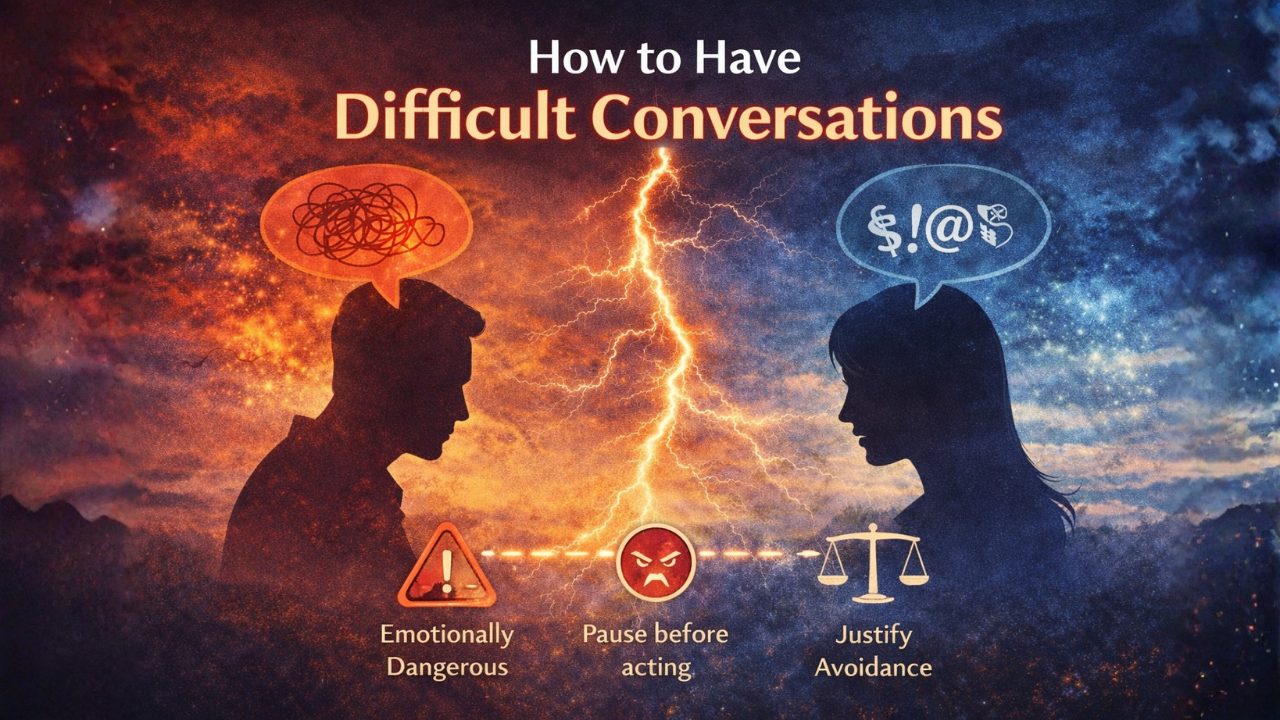
They Feel Emotionally Dangerous
Difficult conversations trigger the same threat response as physical danger. Your heart rate increases. Your mind races. Your body prepares for conflict. From a neurological perspective, discomfort feels like risk, so your brain encourages you to avoid it. That’s why even thinking about a hard conversation can feel exhausting.
Avoidance isn’t laziness. It’s your nervous system trying to protect you. The problem is that what feels emotionally dangerous in the short term is often relationally dangerous in the long term. The best way to overcome this issue is by treating it like any fear. Take a deep breath, change your posture, and focus on the bigger picture or the outcome you are looking for.
We Fear the Emotional Reaction
That might seem obvious, after all, none of us look forward to conversations that might stimulate an emotional reaction. But there’s more to it. We also fear what might come after.
- Will they get defensive?
- Will they be hurt or angry?
- Will it turn into conflict?
- Will it damage the relationship?
Because we can’t control their reaction, our brain fills the gap with worst-case scenarios. That uncertainty keeps us silent. Ironically, the emotional reactions we fear are often worse in our imagination than in real life. And when reactions do happen, they’re usually more manageable than the slow erosion caused by unspoken issues.
The other great irony is that this fear causes us to delay the conversation, and the longer we wait the more likely it is to cause an emotional reaction. It’s much better to have the conversation before it becomes a big issue.
We Justify Avoidance as “Keeping the Peace”
This is the most subtle trap. We tell ourselves we’re being kind, patient, or understanding. We confuse short-term peace with long-term health. But unspoken issues don’t disappear.
They leak out as:
- Passive aggression
- Withdrawal
- Resentment
- Emotional distance
The relationship pays the price, quietly at first, then more loudly over time. What feels like harmony is often just postponed discomfort.
What You’re Really Avoiding
Here’s the uncomfortable truth: You’re not avoiding the conversation. You’re avoiding the discomfort of facing it. And the longer you wait, the more weight that conversation carries.
Silence allows stories to grow unchecked. Assumptions harden into beliefs. Emotions intensify without being tested against reality.
At some point, the conversation you were avoiding becomes harder than the one you needed to have in the first place.
The Shift That Makes Difficult Conversations Possible
Difficult conversations don’t require confidence, clever words, or perfect timing. They require emotional regulation.
The ability to:
- Notice what you’re feeling
- Set it aside long enough to think clearly
- Choose purpose over comfort
This is where emotional intelligence meets self-leadership. When you stop trying to avoid discomfort and start managing it, difficult conversations become possible — not easy, but doable.
Silence Is a Decision Too
Every time you avoid a difficult conversation, you are still choosing something. You’re choosing:
- Short-term comfort over long-term clarity
- Assumptions over understanding
- Peace now over trust later
Sometimes the bravest thing you can do for a relationship isn’t being agreeable. It’s being honest.
Avoiding the conversation feels safer — until the cost of silence gets higher.
A Simple Reflection
Think about a conversation you’ve been avoiding.
Ask yourself:
- What am I afraid will happen?
- What is already happening because I’m staying silent?
- What would change if I approached this calmly, not emotionally?
You don’t need to solve everything today.
But acknowledging the cost of avoidance is often the first step toward saying what needs to be said.
Want to Go Deeper?
Related Resources
- 📖 Book: Listening – A Guide to Building Deeper Connections – available in paperback, eBook, and audiobook.
🎯 Coaching: Book a personal session for personalised support.
💼 Leadership Tips: Subscribe to the Team Focus newsletter here.