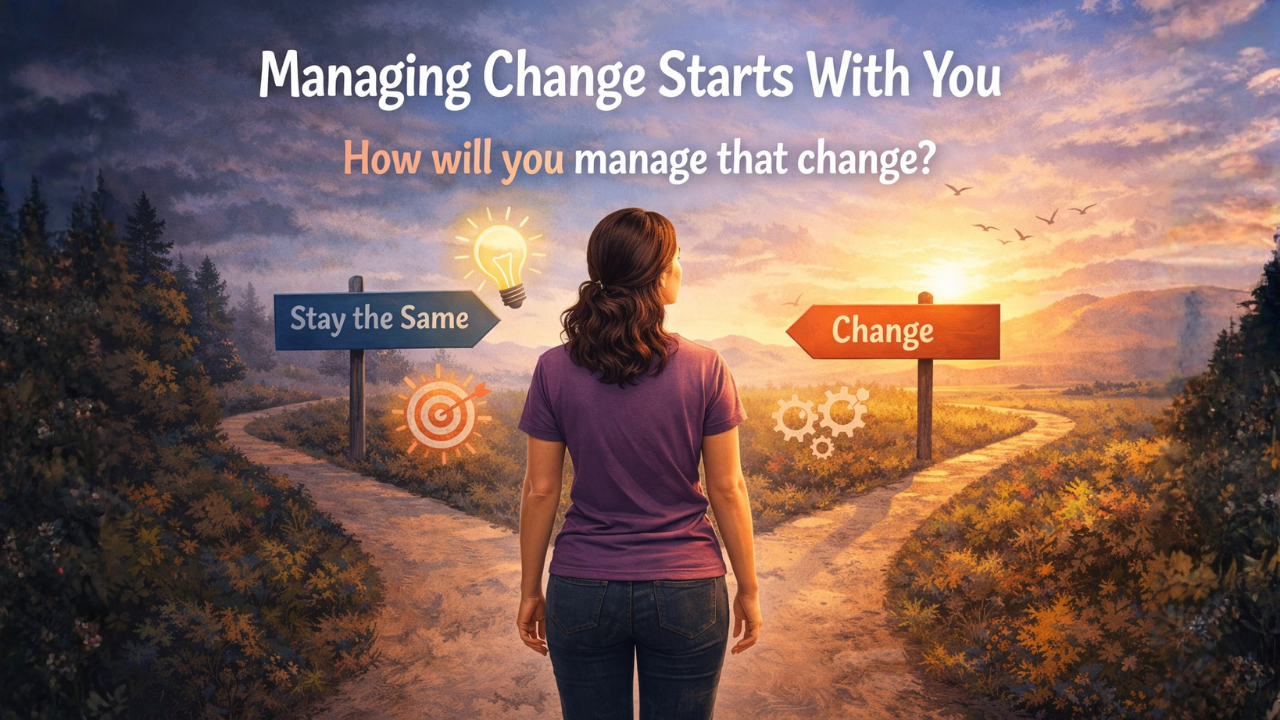
Managing change is a deeply personal thing.
If you’ve decided you want to change something in your life, the most important question isn’t what you want to change, it’s this:
How will you manage that change?
Most people jump straight to outcomes. They decide what they want and hope motivation will carry them through. But real, lasting change requires something more deliberate. It requires a plan.
Change Looks Different in Every Area of Life
Think about the changes you might want to make.
- If you want to improve as a parent, how will you manage that improvement?
- If you want to improve in your sport, how will you manage that progress?
- If you want to change a habit, mindset, or behaviour, how will you manage the transition from who you are now to who you want to become?
Managing change is something we rarely stop to think about. Yet it’s one of the most important steps if you want change to last.
When you take time to plan how you’ll manage change, you dramatically increase your chances of success.
Why So Many Change Efforts Fail
Most people don’t fail because they lack desire. They fail because they don’t know how to manage change.
Instead of planning, they rely on:
- Willpower
- Motivation
- New Year’s resolutions
- Good intentions
And when it gets uncomfortable, as it always does, those strategies fail. To make matters worse, many people react emotionally to the idea of change. They feel fear, resistance, or dread before they even begin.
But change doesn’t have to feel overwhelming.
It can be structured.
It can be simple.
And it can be deeply rewarding.
A Practical Way to Manage Change
In Listening – A Guide to Building Deeper Connections, I introduced a tool called the Integrated Values Iceberg. It was designed to help people manage change in a way that works with their unconscious, rather than against it.
This is important because your unconscious plays a huge role in whether change is supported, or quietly sabotaged. When you use the Integrated Values Iceberg to plan change, you work through it at multiple levels.
Here are the key questions to ask:
- What outcome do I want to achieve?
- What behaviours will I need to adopt to achieve it?
- What mindsets or beliefs will I need to develop?
- Who will I need to become to sustain this change?
- Why does this matter so much to me? What’s the deeper purpose?
That final question is critical.
If you don’t connect to your deeper purpose, motivation will fade the moment things become uncomfortable.
Change Doesn’t Have to Be Hard or Scary
Many of us react to the idea of change as though it’s something being forced on us. But the change we’re talking about here is something you want.
It’s designed to help you:
- Live more effectively
- Improve important relationships
- Perform better
- Feel more aligned with who you want to be
Managing change doesn’t need to be complex or exhausting. When change is aligned at a deeper level, values, beliefs, behaviour, identity, it becomes far easier to maintain.
From Reacting to Managing
The shift is simple but powerful. Stop reacting to the idea of change. Start managing it.
When you intentionally plan change from the inside out, you move from hoping things will improve to actively shaping who you are becoming. And that’s where real change begins.
A Simple Action Step
Think about one change you want to make right now.
Then ask yourself:
- How will I manage this change?
- What level have I been ignoring?
- What would happen if I planned this more intentionally?
If you want a proven framework to guide that process, the Integrated Values Iceberg is explained in detail in Listening – A Guide to Building Deeper Connections.
Change doesn’t need to be feared. It needs to be managed.
Want to Go Deeper?
Related Resources
- 📖 Book: Listening – A Guide to Building Deeper Connections – available in paperback, eBook, and audiobook.
🎯 Coaching: Book a personal session for personalised support.
💼 Leadership Tips: Subscribe to the Team Focus newsletter here.