Finding your Purpose
Do you ever find yourself procrastinating? Putting things off. Getting distracted. Avoiding something you know matters. When this happens, most people blame themselves. They assume they lack discipline, motivation, or willpower. But in my experience, it might be something else. More often than not, procrastination is a sign that you haven’t tapped into your deeper purpose for that specific thing.
Purpose Is a Deep Source of Motivation
Purpose is one of the most powerful motivators you can have. It lives deep within you.
It connects you to something bigger than yourself. And it gives meaning to effort, discomfort, and persistence.
Purpose is your why.
It’s the reason you want something, not just the thing itself. When purpose is clear and compelling, motivation feels natural. When it’s vague or shallow, action becomes hard work.
Why Goals Without Purpose Don’t Work
You can set as many goals and objectives as you like. But if those goals are only about material outcomes, status, money, numbers, or appearances, your motivation will eventually fade.
For example:
- You might set a career goal, but if you haven’t thought about why it matters to you, how hard will you really pursue it?
- You might set a sporting goal, but what’s the deeper reason for wanting it?
- You might set a health goal, like losing weight, but if the number on the scale is the only motivator, then will you commit to the goal or will you self-sabotage?
Without a deeper purpose, your unconscious mind won’t fully support the goal. That’s when procrastination, avoidance, and self-sabotage show up.
Purpose Fills the Gap Between Intention and Action
Purpose fills the gap between:
- Knowing what you should do
- And actually doing it
When you understand why something truly matters:
- You feel more motivated
- You persist longer
- You recover faster from setbacks
Purpose is often bigger than the outcome itself. It’s about contribution. About meaning. About becoming someone, not just achieving something.
Make Purpose Specific (Not Overwhelming)
One of the most common mistakes people make is trying to define their entire life purpose. That’s a big, abstract question, and it often leads to confusion or avoidance. A more effective approach is to think about purpose in specific areas of your life.
For example:
- What’s your purpose as a parent—and why does that matter to you?
- What’s your purpose for your health?
- What’s your purpose in your work or career?
- What’s your purpose in the groups or communities you belong to?
When purpose is specific, it becomes practical—and powerful.
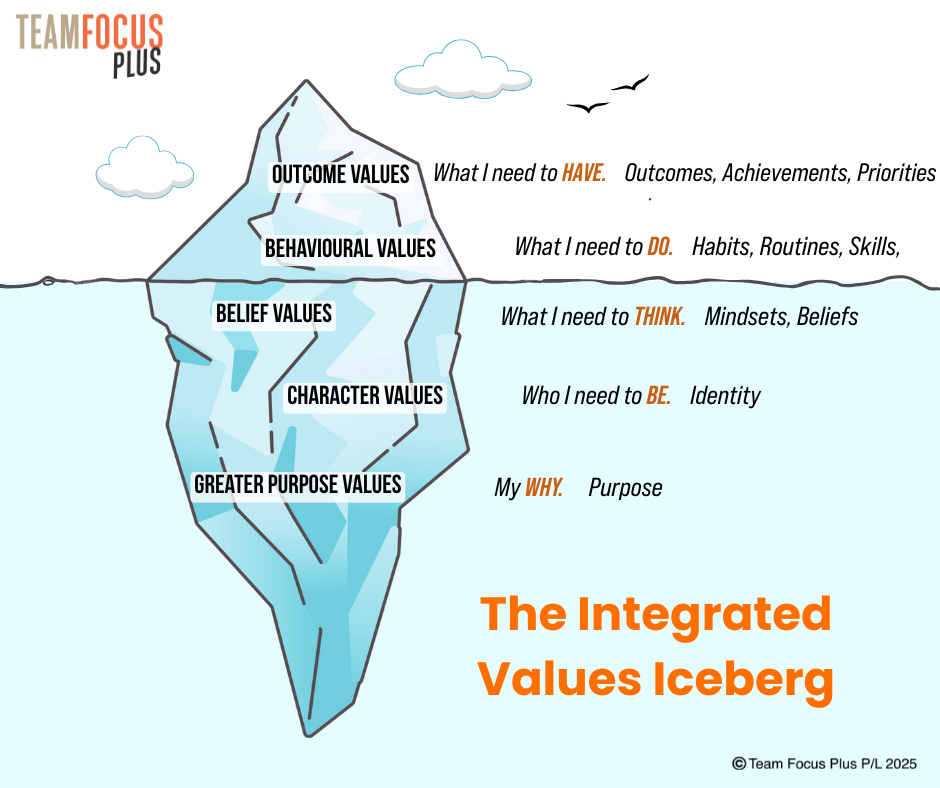
Purpose and the Integrated Values Iceberg
In the Integrated Values Iceberg, purpose sits at the deepest level.
It’s the foundation that supports everything else:
- Who you need to be
- How you need to think
- What behaviours you need to adopt
- What outcomes you need to aim for
When you start with purpose and work upward, motivation becomes sustainable rather than forced.
A Simple Reflection to Try Today
If you’re procrastinating, avoiding, or getting in your own way, pause and ask yourself:
- Do I have a purpose for this specific aspect of my life?
- What am I trying to achieve?
- Why does this matter to me?
- Is my purpose compelling enough?
Don’t underestimate the power of purpose.
It’s a deep, motivating force that drives meaningful change.
If you’d like help clarifying your purpose in a practical way, you can download the Purpose Alignment Worksheet, based on the Integrated Values Iceberg, or explore more resources at rossjudd.com.
When your purpose is clear, action becomes easier—and progress follows.
Want to Go Deeper?
Related Resources
- 📖 Book: Listening – A Guide to Building Deeper Connections – available in paperback, eBook, and audiobook.
🎯 Coaching: Book a personal session for personalised support.
💼 Leadership Tips: Subscribe to the Team Focus newsletter here.